 Clerk2Officer
Last updated · By the Clerk2Officer editorial team · Report a correction
What will you learn?
Understand core banking technology, distinguish rule-based automation from AI, recognise banking applications, evaluate fraud-detector performance, interpret simple expected-loss economics and explain responsible AI governance.
Formula labels and worked outputs are educational examples, not live bank models or regulatory eligibility cut-offs.
0 of 28 lessons marked reviewed in this browser session
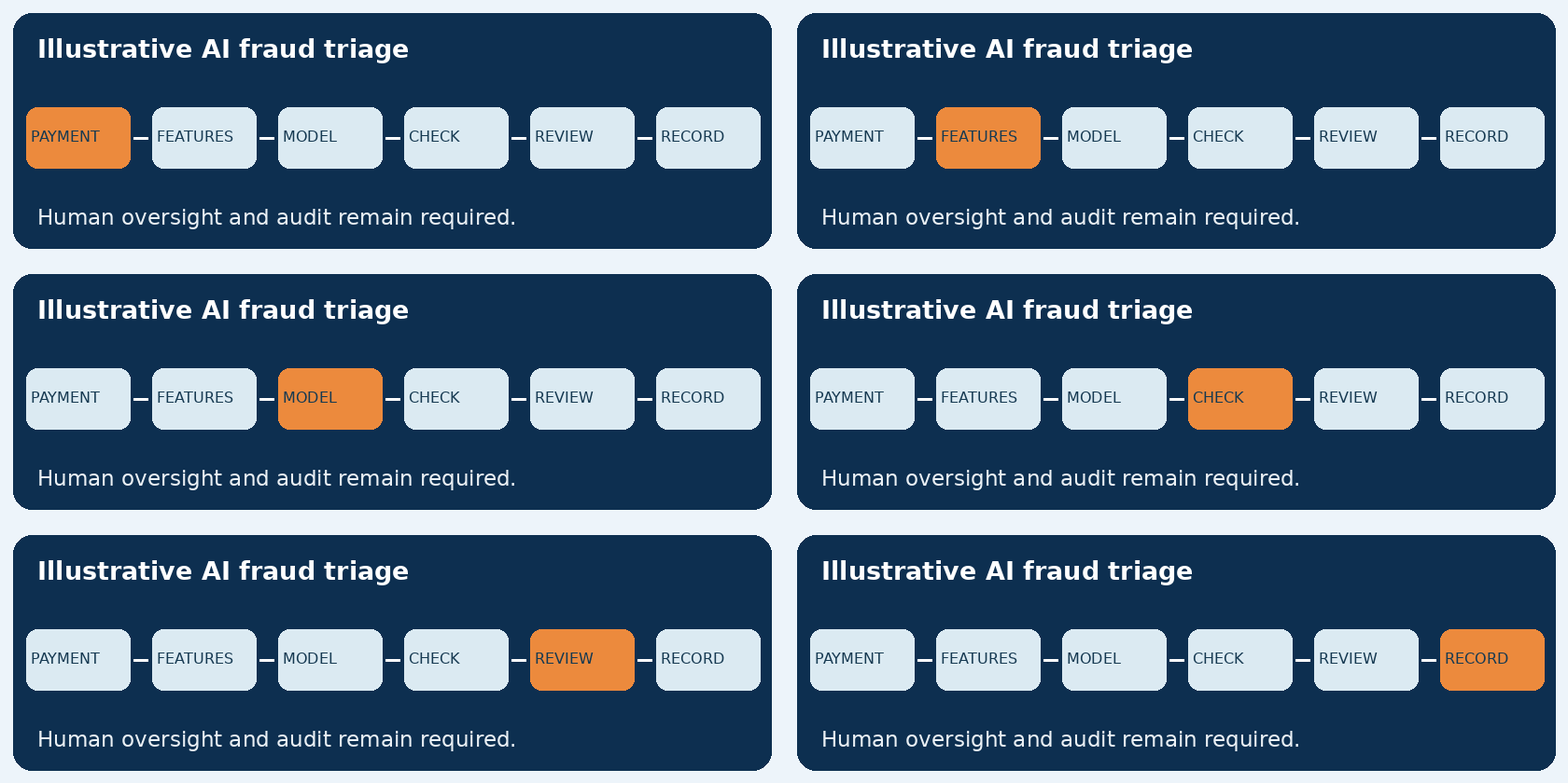
Animated concept: fraud triage with human oversight
Alternative animated GIF
Open animated teaching illustration
LESSON 01 · Dimensions of Banking Technology
Six dimensions of banking technology
A bank's technology is not merely its computers or mobile app. Its dimensions include infrastructure and networks, transaction applications, customer channels, data and analytics, security and controls, and people/process governance. Each dimension affects the others: a fast interface is of little use when the core ledger cannot post the instruction; an accurate decision model is unsafe if its access controls permit unauthorised alteration. To analyse a proposed banking technology initiative, identify the customer problem, the system of record, supporting data, control points, accountable staff and the measurable outcome.
A bank introduces biometric assisted transactions in rural outlets. The visible biometric device is one dimension; reliable connectivity, customer verification, switch connectivity, audit logs, complaint handling and reconciliation are equally necessary. A design that forgets the exception process may disadvantage precisely the customers it intends to serve.
Think of a six-layer stack: channel → access and identity → business rules → data services → core posting → monitoring. These layers are conceptual rather than a mandatory physical design. Each hand-off needs defined inputs, outputs, responsibilities and a failure response.
Exam trap and interpretation
Technology procurement is not equivalent to full business-process transformation.
LESSON 02 · Banking Today
Banking today: hybrid physical and digital
Contemporary banking combines branch relationships, self-service digital channels, assisted digital service and highly automated processing. Customers choose channels based on task complexity, trust, literacy, access and urgency; the cheapest channel is not always the most suitable. Routine statement access may be self-service, whereas disputed fraud claims or complex lending decisions may need assisted investigation. Banks must preserve consistent account information and service records across these channels. The economic objective is not to remove people indiscriminately but to deploy employee time where judgement adds value.
A customer begins an address-change request through mobile banking but cannot upload a document. A branch employee should retrieve the existing service request securely and continue it, rather than creating two conflicting cases. The same service ID helps prevent inconsistent customer-facing answers.
Define a journey's success using completion, customer effort, error/rework rate, complaint incidence and control effectiveness. A high app-download count does not show that customers completed useful transactions.
Exam trap and interpretation
Digital-first need not mean digital-only, particularly for vulnerable customers.
LESSON 03 · Relationship between Banking and Technology
How banking and technology shape each other
Banking creates demand for dependable ledgers, identity controls, payment switching, clearing, audit trails and regulatory reporting. Technology, in turn, creates new products and service expectations. Core banking changed the meaning of the home branch; electronic payment rails altered how customers send money; advanced analytics can change the timing of fraud detection. The relationship is iterative: a business rule determines what software must enforce, while new technical capabilities create opportunities to redesign that rule subject to governance.
A bank initially alerts suspicious transfers only in an end-of-day report. Streaming transaction data makes it possible to intervene earlier, but requires a decision about who may temporarily stop a transaction, when a human reviews it and how a legitimate customer can obtain relief.
Distinguish business outcomes from technical metrics. An API latency of 150 milliseconds is not a sufficient outcome if transactions still fail after authorisation; conversely, a slightly slower flow that prevents duplicate debits may deliver more trust.
Exam trap and interpretation
New capability should not silently bypass existing customer protection or approval controls.
LESSON 04 · Evolution of Banking Technology
Evolution: branch ledgers to integrated networks
The long-term progression of banking technology moved from paper-based branch records to electronic ledger systems, branch automation, interconnected core banking, internet/mobile channels and data-driven decision support. These stages overlap rather than replacing one another on a single national launch date. Many banks still operate legacy services alongside modern platforms. A technology migration needs data-quality checks, reconciliations, continuity planning and training because historical records and customer rights cannot be abandoned during platform replacement.
A branch migrates loan accounts from a legacy application into a new core platform. Even if balances match, the migration team must check interest schedules, due dates, accrued charges, customer identifiers, securities and restrictions; otherwise customers can be impacted after the cutover.
View technological change as a sequence of capabilities: record → connect → transact remotely → automate decisions → explain and monitor decisions. AI is a later capability layer, not an alternative to sound ledger controls.
Exam trap and interpretation
Do not assume that replacing a front-end app modernises the accounting system behind it.
LESSON 05 · A New Era in Banking
New era: APIs, real-time data and AI
The newer era of banking combines APIs, cloud-enabled computing, event-based data processing, biometrics, machine learning and conversational interfaces. APIs let authorised services exchange specific data; real-time events support monitoring; AI models may classify, predict or generate text. Each capability has a different failure mode. Cyber incidents, model errors and vendor outages can propagate rapidly across connected services, so architecture should contain failures and provide controlled fallbacks. A bank needs to know when automation is safe and when a human must decide.
A customer receives an immediate application status from a chatbot, but the actual sanction depends on credit checks and approval authority. The bot can explain the workflow but must not promise disbursement merely because its text-generation model predicts that approval is likely.
Differentiate a rule-based workflow, a predictive model and generative AI. Rules apply explicitly encoded conditions; predictive models estimate patterns; generative models produce content and require factual validation.
Exam trap and interpretation
Real-time response does not necessarily imply real-time final settlement or final credit approval.
LESSON 06 · Evolution of Banking Technology in India
Evolution of banking technology in India
India's banking technology evolved through computerisation, branch networking, core banking adoption, national electronic payment networks and mobile-first services. Public digital infrastructure, identity services and payment rails support widespread use, but are not a single product or managed by one institution. Exam preparation should emphasise what technology does and which institution is responsible, rather than memorising unsupported adoption numbers. The different periods overlap, and the launch date of a system differs from the date an individual bank adopted it.
A bank connects its accounts to digital payments. It still needs beneficiary checks, authentication, fraud controls and dispute processes. The availability of a common payment rail alone cannot determine whether a customer transaction is safe or successful.
Build a role map for questions: core banking is the account/ledger system; a payment rail enables interbank messaging or switching; an app is the customer interface; a bureau holds credit information; an AI model provides an estimate or classification.
Exam trap and interpretation
Do not confuse digital public infrastructure with a particular commercial bank's product.
LESSON 07 · Challenges towards adoption of Technology by Indian Banks
Adoption constraints for Indian banks
Technology adoption faces legacy integration, fragmented data, talent shortages, cybersecurity threats, vendor dependencies, financial constraints and uneven customer digital literacy. Rural bandwidth and device accessibility may affect performance while language barriers raise customer-service costs. Model adoption introduces bias, explainability and changing-data risks. Banks should prioritise use cases by business benefit, legal permissibility, model reliability, integration complexity and customer harm potential. Full automation of a weak process typically scales its errors faster.
A fraud model trained predominantly on urban transactions flags rural cash patterns as anomalous. The bank must test performance across contexts, investigate disproportionate false positives and avoid simply blocking a whole customer category.
A useful implementation sequence is problem identification → data fitness → controlled pilot → policy approval → staged deployment → monitoring and rollback. Governance and operations continue after go-live.
Exam trap and interpretation
A model is not fair merely because it excludes an explicit demographic field; proxies may remain.
LESSON 08 · Technology in Retail Banking
Technology uses in retail banking
Retail banking uses technology for onboarding, payment initiation, account servicing, e-statements, customer communications, fraud detection, credit origination, collections support and wealth-service delivery. Some of these functions require no AI at all: fixed deposit interest calculation and transaction posting should be reproducible, governed by approved accounting and product rules. AI can assist in prioritisation or interpretation but should not replace dependable deterministic computation when exact accounting is required.
A retail bank uses document recognition to extract information from uploaded KYC documents. Extraction errors are checked against approved identity-verification procedures. The document reader may assist staff, while the bank remains responsible for completing required due diligence.
Ask whether a proposed AI use case improves accuracy, accessibility, response speed or cost after including review and remediation expenses. A chatbot answering simple FAQs is different from an AI system exercising credit discretion.
Exam trap and interpretation
Not every digital process should be branded AI; deterministic validation is often preferable.
LESSON 09 · Benefits of Technology in Retail Banking
Benefits of technology in retail banking
Benefits can include easier customer access, lower routine transaction costs, improved accuracy, faster service, better availability of information, scalable product servicing and richer audit evidence. These benefits arise only when customer journeys work end-to-end and controls remain effective. Faster execution can also increase fraud velocity, so monitoring should accompany improved throughput. Management must measure outcomes against a credible baseline and separate gross savings from licence, cloud, maintenance, security and human-review costs.
Manual processing costs ₹35 per service request while automated variable processing costs ₹9. For 20,000 eligible requests, apparent gross variable saving is ₹5.2 lakh. If annual fixed system and oversight cost is ₹3 lakh, simplified net benefit is ₹2.2 lakh, excluding transition and other effects.
When calculating technology ROI, show the time horizon and denominator. ROI = (benefits − costs)/costs ×100%; projected benefits are not guaranteed benefits.
Exam trap and interpretation
Digitising an error-prone service can increase complaints even as nominal cost per request falls.
LESSON 10 · Artificial Intelligence (AI)
Artificial intelligence: what the term means
Artificial intelligence refers to computational techniques that perform tasks ordinarily associated with intelligent interpretation, prediction, recognition or language handling. In banking, supervised machine learning can estimate the probability of a defined outcome from labelled historical data, while natural-language processing can classify customer messages. AI output is an estimate or generated response, not a legal fact or authority. Accuracy depends on the quality and representativeness of training data, evaluation design, operating conditions and controls against leakage.
A model estimates a loan applicant's probability of default using permitted information. The number is a risk estimate to be interpreted alongside bank policy, verified income and other underwriting evidence. It is not a bureau credit score, nor is it a final loan sanction.
Separate training from inference. Training learns patterns from a defined dataset; inference applies the learned model to new inputs. Model validation must be independent of the data used for fitting, with careful handling of temporal leakage.
Exam trap and interpretation
An AI recommendation is not automatically a verified truth or an authorised instruction.
LESSON 11 · Difference between Artificial Intelligence (AI) and Automation
AI versus automation: exam-critical comparison
Automation executes work with limited manual intervention. Traditional rule-based automation follows explicit instructions such as “if required fields are missing, return the form”. AI systems infer from examples or generate text and may behave probabilistically. AI can be part of an automated workflow, but they are not synonyms. A bank can automate EMI calculation without AI, and an AI fraud system can provide a recommendation that a human reviews before action. Determinism, auditability and risk decide the suitable method.
A fixed rule flags transfers over an approved risk threshold. A supervised model may assess a combination of transfer amount, device change and previous patterns to generate a risk score. Both are automated operations; only the model-driven inference uses AI. The final control action follows approved policy.
Rule-based controls are often best for precise regulatory or accounting logic. Models add value when patterns are too complex to encode, but must be evaluated for false positives, bias and drift.
Exam trap and interpretation
Using software does not make an activity AI; using AI does not remove human accountability.
LESSON 12 · Evolution of Artificial Intelligence
Evolution of AI: rules to data-driven models
Early AI relied heavily on hand-built symbolic rules and expert systems. Improvements in data availability, computing power and learning algorithms enabled statistical machine learning and deep learning. More recently, large language models and generative AI can produce natural-language answers, summaries and code. These generations coexist in a bank because they solve different problems. A fixed regulatory eligibility check should remain verifiable even when a conversational model explains the check to a customer.
An early expert-system-style credit assessment applies a policy checklist; a supervised model estimates risk; a modern language model summarises a service complaint. The three systems cannot be substituted blindly because their outputs, verification needs and error profiles differ.
A timeline question tests concepts, not a rigid single-year transition. Avoid claiming that generative AI replaced all earlier technology; payment switching, core ledgers and validation engines continue to serve essential functions.
Exam trap and interpretation
A language model producing plausible text may still invent fees, approval decisions or regulatory rules.
LESSON 13 · Artificial Intelligence Industry in India
Artificial intelligence ecosystem in India
India's AI ecosystem includes public research institutions, technology companies, startups, financial institutions, academic programmes, cloud and chip infrastructure, and government-supported initiatives. The Union Cabinet approved the IndiaAI Mission on 7 March 2024 with an outlay of ₹10,371.92 crore, according to PIB. That figure is the announced mission outlay, not evidence that every rupee has been disbursed or that a bank has received funding. Public programmes aim to improve compute access, datasets, skills, indigenous capabilities and responsible development.
A regional bank evaluating an Indian-language service assistant could consider locally relevant training data and inclusivity, but still must test the supplier, language accuracy, customer confidentiality, uptime, fallback and contractual access controls.
The 2026 PIB description identifies seven IndiaAI Mission pillars. Different reports may reorganise their labels; a candidate should retain the fact's issuing authority and publication date when quoting a number.
Exam trap and interpretation
A national mission's budget is not the amount spent by the banking industry on AI.
LESSON 14 · Artificial Intelligence in Indian Banking Industry
AI adoption in the Indian banking industry
Banks can apply AI in customer interaction, fraud review, document analysis, demand forecasting, collection prioritisation, internal knowledge retrieval and operational risk monitoring. Deployment maturity differs widely: experimentation and proof of concept do not mean an application has production approval. Models require change control, outcome monitoring and independent validation. Third-party AI does not transfer a regulated entity's customer-service or risk responsibilities to a technology supplier.
A bank pilots a model to classify disputed-card complaints. A correct pilot result is not enough; the production design must define data access, complaint routing, human override, language testing, confidence thresholds, escalation and retention of supporting records.
A useful model inventory records ownership, purpose, training and validation data, version, approved users, dependencies, limitations, escalation procedure and withdrawal process. That inventory is a governance recommendation, not proof of a universal regulatory form.
Exam trap and interpretation
A vendor's claimed accuracy is not a substitute for bank-specific validation.
LESSON 15 · Indian Banks and the Technology
How Indian banks integrate AI with existing technology
A practical banking AI stack draws data from authorised sources, validates quality, transforms features, invokes the model, applies business rules and records an auditable decision. Core banking remains the accounting system of record; an AI service should not silently bypass posting controls. Legacy integration may require message queues or APIs with explicit timeouts, retries and permission checks. Security, data lineage, monitoring and incident response operate across the stack.
A fraud model receives a transaction's risk features through a controlled API. The rules engine interprets the model score under an approved threshold and, if necessary, sends the case to a reviewer. The ledger remains the authoritative record of the transaction's financial effect.
Model-serving failure needs a documented fallback: reject, queue for review, use an approved rules-only path or temporarily restrict a service, depending on customer risk and bank policy. Do not improvise a response after an outage.
Exam trap and interpretation
The prediction service is not itself the accounting authority or the transaction settlement system.
LESSON 16 · Why AI in Banking Industry?
Why a banking business would use AI
AI is useful when a high-volume decision or interpretation problem involves patterns that conventional fixed rules struggle to capture. Examples include transaction anomaly ranking, speech-to-text complaint classification and detection of unusual shifts in portfolio behaviour. Adoption should be problem-led: define the cost of current errors, customer impact, available data and action that follows a model score. More model complexity is not always better; a transparent simple model can outperform a complicated one operationally when its outputs are easier to explain and govern.
A branch network receives 12,000 free-text customer complaints monthly. An AI classifier might route messages to the right desk sooner, but high-risk or ambiguous complaints should be referred to trained staff rather than automatically closed.
Evaluate the base rate of the target event. Even a high-accuracy fraud classifier may generate many false alerts when fraud is rare. Precision, recall and false-positive rate are more informative than a single accuracy percentage.
Exam trap and interpretation
AI should address a defined customer or operational problem, not merely improve a technology-adoption score.
LESSON 17 · Benefits of Artificial Intelligence Technology in Banking and Finance
Benefits of AI in banking and finance
Appropriately controlled AI may improve early detection of anomalies, personalise useful information, reduce manual document review, assist multilingual service, triage cases and identify emerging risk patterns. These are potential benefits, not guaranteed bank outcomes. Each use case needs a baseline and a balanced scorecard: accuracy, error severity, fairness, customer complaints, resilience, cost and compliance. Human staff can focus on exceptions and complex judgement when routine classification is reliable.
Suppose 120 confirmed fraud attempts are correctly flagged, 80 legitimate transfers are wrongly flagged and 30 frauds are missed. Alert precision is 120/(120+80)=60%; recall is 120/(120+30)=80%. A bank must evaluate both prevented losses and disruption to the 80 legitimate customers.
Precision answers “of the flagged cases, how many were truly positive?” Recall answers “of all actual positive cases, how many did we find?” These denominators are different and feature heavily in objective exam questions.
Exam trap and interpretation
A higher alert count need not mean better fraud detection if false positives increase disproportionately.
LESSON 18 · Artificial Intelligence in Retail Banking
AI in customer-facing retail banking
Customer-facing AI includes service assistants, document understanding, personalised product explanations, proactive account insights and human-agent support. Generative answers must be grounded in approved product information and current policy, with an easy path to a human for consequential questions. A banking assistant should not invent interest rates, promise approval, request an OTP, present suitability assessments as guarantees or reveal one customer's details to another. Service metrics must examine factual correctness and complaint resolution, not only the number of interactions diverted.
A customer asks whether a disputed debit will be reversed today. A controlled assistant verifies the approved workflow and case status before answering, explains the next step, and escalates where a precise commitment cannot be supported by the bank's records.
Separate FAQ assistance from regulated decisions. Drafting a response is different from authorising a waiver, changing a loan contract or concluding a fraud investigation.
Exam trap and interpretation
A fluent chatbot answer is not reliable solely because it sounds professional.
LESSON 19 · Artificial Intelligence in Retail Banking in India
AI applications in Indian retail banking
In India, multilingual and assisted banking needs make inclusive design particularly important. AI can assist with Indian-language queries, document extraction, agent guidance and anomaly detection, but language and dialect performance must be evaluated. A model trained only on metropolitan customer patterns may fail in rural settings. Where third parties provide technology, banks must assess access rights, auditability, customer grievance routes and data transfer. Financial inclusion should mean lower service barriers without weakening authentication and suitability controls.
A regional customer speaks a local-language complaint about an unauthorised transaction. Speech recognition generates a draft summary, but the reviewer verifies essential details, confirms the right customer and tracks complaint resolution under the bank's actual process.
Measure success by segment and channel. A low average error rate can hide a very high error rate for elderly users, rare languages or low-connectivity environments.
Exam trap and interpretation
Do not treat a statistical group difference alone as proof of unlawful discrimination; investigate causes and relevance.
LESSON 20 · The Challenges Facing India’s AI Development
Challenges confronting India’s AI development
AI faces challenges in reliable and representative data, compute resources, language diversity, security, skill availability, vendor concentration and governance capacity. Financial services add heightened risks from personal data, harmful denial of service, model manipulation and inability to explain consequential outcomes. Banks should test models over time, log material changes, control data access and plan for outages. Transparency should be appropriate to the decision; simply showing a numeric score is not a complete explanation to a customer.
A model trained during a stable period suddenly faces new fraud patterns. Its alert precision falls and legitimate customers begin receiving too many holds. Drift detection should trigger diagnosis, threshold review, possible retraining, change approval and customer-impact monitoring.
Population Stability Index (PSI) is one possible drift indicator. PSI uses the distribution of input characteristics; it does not itself establish model discrimination, forecasting accuracy or legal compliance. Zero proportions require smoothing.
Exam trap and interpretation
Training on more personal data is not automatically lawful, ethical or technically necessary.
LESSON 21 · Benefits of AI in Retail Banking
Benefits of AI specifically for retail banking
Retail banking generates many relatively small customer interactions across products and channels. Properly governed AI can improve 24×7 query assistance, customer-service routing, fraud triage, service personalisation, routine document handling and proactive remediation. The strongest value may be better outcomes rather than merely lower headcount cost. Benefit measurement should deduct inference costs, monitoring, exception processing, complaint handling, cybersecurity and migration expenses.
A bank automates 65% of 40,000 simple monthly customer inquiries. If assisted servicing costs ₹28 per case and bot-variable cost ₹4 per automated case, the illustrative monthly gross variable saving is 26,000×₹24 = ₹6,24,000. Fixed deployment and oversight expenses must be deducted before claiming net benefit.
Report the share of safely resolved cases, not just bot-handled interactions. A customer who must repeat the entire issue to a human has not achieved real end-to-end resolution.
Exam trap and interpretation
Technology success should be evaluated in customer, operational, risk and financial dimensions together.
LESSON 22 · Applied revision extension
RBI FREE-AI committee and responsible governance
On 13 August 2025 the RBI publicised its committee report on a Framework for Responsible and Ethical Enablement of Artificial Intelligence (FREE-AI) in the financial sector. The committee described seven foundational “Sutras”, 26 actionable recommendations and six strategic pillars. This is a report setting out a recommended direction; it should not be misrepresented as a standalone binding direction that automatically requires every bank to implement each recommendation. The management lessons are nevertheless clear: trustworthy deployment requires appropriate oversight, resilience, data security, accountability, independent evaluation and attention to customer rights.
A branch support chatbot is placed before an internal approval committee. The proposal should include evidence of factual testing, data use, provider security, incident response, escalation rights, monitoring metrics and a rollback route, not simply a demonstration of fluent answers.
Distinguish date of RBI committee establishment (26 December 2024), publication of its report (13 August 2025), and any separate binding direction subsequently issued. Do not silently transform advisory work into enacted rules.
Exam trap and interpretation
7 Sutras, 26 recommendations and 6 pillars refer to the RBI FREE-AI committee report, not the IndiaAI Mission pillars.
LESSON 23 · Applied revision extension
Fraud detection: confusion matrix and thresholds
A binary classifier compares model alerts against subsequently verified outcomes. True positives (TP) are correctly flagged frauds; false positives (FP) are legitimate transactions wrongly flagged; false negatives (FN) are frauds missed; true negatives (TN) are legitimate transactions correctly cleared. Precision = TP/(TP+FP), recall = TP/(TP+FN), specificity = TN/(TN+FP). F1 is the harmonic mean of precision and recall. Threshold changes typically alter both recall and false-positive burden. A threshold should be authorised and tested, not chosen only to maximise flagged transactions.
In a review set of 10,000 payments, TP=90, FP=210, FN=30, TN=9,670. Precision=30%, recall=75% and specificity≈97.87%. The model's overall accuracy is 97.6%, but 70% of alerts are false positives; this makes “accuracy” alone a misleading success measure.
Fraud is often rare. A model can be accurate in aggregate by predicting the majority class, yet miss nearly every important case. Use the confusion matrix, absolute case counts and loss severity.
Exam trap and interpretation
A 98% accuracy model is not necessarily good at fraud detection when fraud prevalence is below 1%.
LESSON 24 · Applied revision extension
AI-assisted lending: prediction versus sanction
Machine-learning credit systems can estimate probability of default (PD), while expected loss concepts also use exposure at default (EAD) and loss given default (LGD). A simplified expected loss = PD×LGD×EAD; real bank provisioning and capital requirements follow applicable accounting and regulatory frameworks and may need further factors. AI scores are inputs, not substitutes for verified documents, affordability checks, product policy, fair treatment and sanction authority. Controls must prevent unauthorised bias, inaccurate data and misleading automated explanations.
Illustrative portfolio exposure ₹10 crore with PD 2% and LGD 35% gives expected loss ₹7 lakh. This is a one-period teaching example; it does not determine an individual borrower's eligibility or the exact accounting provision required of a bank.
A credit risk score and credit bureau report serve different roles. The model estimates a defined outcome on permitted features; the bureau report compiles credit information. Human-approved policy decides how to combine them.
Exam trap and interpretation
Do not present a model risk estimate as an RBI-prescribed credit cut-off or guaranteed loss.
LESSON 25 · Applied revision extension
Responsible AI: explainability, fairness and privacy
Explainability helps a reviewer understand the factors behind a model recommendation. Fairness checks examine whether errors and outcomes differ unjustifiably across appropriate cohorts, taking account of legitimate risk characteristics and legal restrictions. Privacy requires controlled purposes, minimisation, retention policies and access logging; user consent alone does not cure unjustified overcollection. Security includes protection against prompt injection, sensitive-data disclosure, model theft and adversarial attacks. High-impact outputs should allow appeal or human review in line with bank policy and applicable law.
A customer complains that a loan was denied due to an alleged salary mismatch. The bank should investigate verified records and actual decision factors. The assistant must not expose raw model internals or another customer's data while explaining the specific case and escalation route.
Approval-rate differences do not, by themselves, establish unfairness: check data quality, eligibility mix, policy grounds and error rates. Conversely, apparently equal aggregate acceptance can hide uneven wrongful denials.
Exam trap and interpretation
AI fairness cannot be reduced to a single metric or a checkbox at go-live.
LESSON 26 · Applied revision extension
Model monitoring, drift and change control
A model that works at launch may deteriorate when the economy, customer behaviour or fraud techniques change. Governance should define baseline performance, independent validation frequency, data drift indicators, alert thresholds, human override, incidents and approved retraining. Input-data drift differs from concept drift: the former changes feature distributions, while the latter changes the relationship between features and outcomes. Model version and decision logs permit root-cause investigation and controlled rollback.
An October fraud model shows 80% recall in the validation sample, but the next quarter's recall falls to 52%. The owner checks label delays and sample composition before changing thresholds, reports the operational risk and validates any revised model against fresh holdout data.
Tracking the average input amount is insufficient when the mix across customer groups shifts. A distribution-based measure such as PSI may assist, but only together with outcome and control metrics.
Exam trap and interpretation
Retraining a model without independent validation can hide rather than solve performance deterioration.
LESSON 27 · Applied revision extension
Case lab: chatbot economics and service quality
A chatbot business case should include implementation cost, ongoing provider fees, per-interaction cost, training, human escalation, quality audits and remediation. Deflection rate alone can overstate benefit if customers return repeatedly or unresolved tickets are counted as successes. Track resolution without repeat contact, human transfer, factual error rate, complaints and accessibility. In complex or urgent banking matters, an escalation may be a positive control rather than a chatbot failure.
A bank receives 50,000 monthly inquiries. The bot resolves 30,000 with no repeat contact; assisted unit cost is ₹30, bot marginal cost ₹5. Gross variable benefit is ₹7.5 lakh/month. After ₹4 lakh monthly platform and quality costs, illustrative net operating benefit is ₹3.5 lakh, ignoring other transition items.
For forecasting, state whether a fixed monthly cost is added and whether the automated count means conversations begun, answers delivered, or cases safely resolved. Only the last denominator strongly supports customer outcome claims.
Exam trap and interpretation
A high chatbot containment percentage can coincide with poor customer satisfaction.
LESSON 28 · Applied revision extension
Bank operations implementation and accountability
A mature bank pilot names a business owner, IT owner, model risk or validation owner, information-security reviewer and customer-complaints owner. Requirements define authorised input fields, decision authority, fallback, log retention, performance metrics and escalation. Testing includes false and positive cases, adverse customer journeys, security attempts, language variation and recovery from external-service timeouts. Production change management should support versioned deployments, audit evidence and rollback without damaging account balances or existing complaint records.
A loan-document classifier is introduced in ten branches. Before wider release, the bank checks document extraction across local languages, rejects unreadable files rather than inventing values, audits override reasons and compares false rejection rates between assisted and digital channels.
A system can pass software tests and still fail business acceptance.
Exam trap and interpretation
High numerical accuracy does not eliminate operational, conduct or cybersecurity risk.
Interactive Concept Lab: 16 tools
Change inputs to explore trade-offs in AI performance, risk, cost, quality and banking operations. These calculations are simplified exam illustrations.
Fraud alert precision
TP / (TP + FP)
Fraud detection recall
TP / (TP + FN)
Legitimate-payment specificity
TN / (TN + FP)
Classification accuracy
(TP + TN) / Total
Fraud alert F1 score
2 × Precision × Recall / (Precision + Recall)
Investigation workload
Alert count / reviews per hour
False-positive operational cost
False alerts × handling cost
Illustrative expected credit loss
EAD × PD × LGD; not a prescribed accounting provision
AI service net monthly benefit
Volume × (assisted: AI variable cost), fixed cost
Simple annual ROI
(annual net benefit / initial investment) × 100
Successful straight-through processing
Successful cases / total cases
Digital cost per completed service
Total cost / successfully completed units
Reduction in fraud loss
(baseline, observed) / baseline
Recall change across periods
Difference in percentage points; investigate data and label quality
False positive complaint incidence
Complaints / wrongly alerted customers
AI investment payback
Initial investment / positive monthly net benefit
Decision-path simulator
An AI model flags a loan application as high risk. First validate input data, apply approved credit policy and provide an accessible human escalation path; the model does not sanction a loan.
Facts & Figures · checked 19 October 2026
Government and RBI source dates are shown. The FREE-AI report is an advisory committee report, not automatically a binding RBI direction.
| Topic | Date / scope | Fact | Source |
|---|---|---|---|
| 2026 syllabus | IIBF 2026 | 21 named subtopics in P4B09, Role of AI and Technology in Retail Banking | IIBF JAIIB Rules & Syllabus 2026, Paper IV Module B |
| RBI FREE-AI committee established | 26 December 2024 | RBI constituted the committee to study responsible AI in the financial sector | RBI press release, 13 August 2025, FREE-AI committee report |
| FREE-AI report published | 13 August 2025 | 7 Sutras, 26 actionable recommendations, 6 strategic pillars; a committee report, not automatically binding instructions | RBI press release, 13 August 2025, FREE-AI committee report |
| IndiaAI Mission approved | 7 March 2024 | Union Cabinet approved mission with ₹10,371.92 crore announced budget outlay | PIB, 7 March 2024: Cabinet approval of IndiaAI Mission |
| IndiaAI Mission pillar count | 30 July 2026 | Government described 7 mission pillars for infrastructure, datasets, applications, skills and trusted AI | PIB, 30 July 2026: AI mission pillars |
| Precision: formula | Concept (no regulatory threshold) | TP/(TP+FP); measures proportion of alerts truly positive | Educational formula |
| Recall: formula | Concept (no regulatory threshold) | TP/(TP+FN); measures proportion of actual positives detected | Educational formula |
| Expected loss: simple teaching model | Concept, illustrative | PD×LGD×EAD; not itself the required accounting provision | Educational formula |
25 original MCQs with full explanations
Answer each question and check the explanation. Your answers are not transmitted or saved.
Question 1. Which statement most correctly distinguishes AI from rule-based automation?
Correct answer: D. Automation describes performing tasks with little manual work. Traditional rules apply specified conditions, whereas AI can estimate patterns or produce generated outputs. AI may be embedded within an automated system, but the two terms are not equivalent. A fixed deposit interest calculator generally needs correct deterministic rules rather than a prediction model.
Question 2. A bank uses a fixed rule to reject an onboarding form missing a compulsory field. This is primarily:
Correct answer: C. The input is checked against a precisely encoded condition, and the output follows the defined validation rule. No model needs to learn from examples. Such deterministic controls are often preferable for mandatory forms because the requirement and resulting decision are transparent and reproducible.
Question 3. Which bank system should remain authoritative for the financial account posting?
Correct answer: B. The core transaction/ledger environment, or another properly designated source system, records authorised financial effects. AI services can assist in detecting risk or explaining a journey, but should not independently create a contradictory source of truth for balances or transactions.
Question 4. RBI publicised the FREE-AI committee report on which date?
Correct answer: A. RBI announced the committee’s report on 13 August 2025. The committee itself was established on 26 December 2024, making those two dates easy to confuse. The report outlined principles and recommendations rather than automatically creating a new standalone binding master direction.
Question 5. The RBI FREE-AI committee report contained:
Correct answer: D. The August 2025 report described seven foundational Sutras, 26 actionable recommendations and six strategic pillars. These three figures refer to the RBI committee framework; they are not the seven pillars of the separate Government of India IndiaAI Mission.
Question 6. The IndiaAI Mission approved in March 2024 had an announced outlay of:
Correct answer: C. The Union Cabinet approved IndiaAI Mission on 7 March 2024 with an outlay of ₹10,371.92 crore according to the Press Information Bureau. This is an approved mission budget, not a measurement of AI spending by banks or actual funds disbursed.
Question 7. A fraud system flags 200 payments, of which 120 are confirmed fraud. Its alert precision is:
Correct answer: B. Precision = true positives / (true positives + false positives). There are 120 correctly flagged cases among 200 flagged cases, so precision = 120/200 = 0.60 = 60%. Recall cannot be computed without knowing the number of fraud cases missed.
Question 8. A model identifies 80 actual frauds and misses 20. What is recall?
Correct answer: A. Recall = TP/(TP+FN) = 80/(80+20) = 80%. It measures the share of actual frauds identified, not the share of alerts that are true. A lower detection threshold may improve recall but create more false positives.
Question 9. TP=60, FP=40, FN=20, TN=880. What is specificity?
Correct answer: D. Specificity = TN/(TN+FP) = 880/(880+40)=880/920≈95.65%. It measures the share of truly negative/legitimate cases correctly cleared. Precision and recall have different denominators and must not be substituted.
Question 10. A bank has PD 2%, LGD 40% and EAD ₹50 lakh. Simplified expected loss equals:
Correct answer: C. Teaching-model expected loss = PD×LGD×EAD = 0.02×0.40×₹50,00,000 = ₹40,000. This simplified calculation is useful for understanding the factors but must not be presented as the bank’s complete accounting provision or mandatory regulatory computation.
Question 11. Which metric best exposes customers wrongly blocked by a fraud alert?
Correct answer: B. A false positive occurs when a legitimate transaction is classified as suspicious. Its count and rate help explain customer inconvenience, escalation costs and service failures. Reporting only alerts may reward an excessive threshold that stops many harmless transactions.
Question 12. A bank improves automation speed but complaint volumes double. Which is the best interpretation?
Correct answer: A. Faster processing is only one indicator. Complaint rates, reversals, factual errors, rework and service accessibility reveal whether customers benefited. Efficiency gains that amplify harm or create extra human work may not yield a positive risk-adjusted return.
Question 13. An AI chatbot states that an unapproved loan is sanctioned. The main defect is:
Correct answer: D. Generative language can sound convincing without reflecting the actual credit workflow. Sanction requires authorised checks and approval; customer communication should be grounded in system-of-record status. The design must escalate uncertainty rather than promise a financial outcome.
Question 14. Which step is important when an AI model trained on urban customers is used in rural branches?
Correct answer: C. A shift in data distributions or customer behaviours can reduce model reliability. Testing by relevant channel and customer context, together with data-quality and fairness checks, is necessary before wide use. Deployment should include escalation and rollback paths.
Question 15. What does model drift mean?
Correct answer: B. Input/data drift refers to changing feature distributions; concept drift refers to changing relationships between features and outcomes. Monitoring and validation help detect performance degradation, but drift signals do not automatically prove bias or an unauthorised transaction.
Question 16. Which statement about the FREE-AI committee report is most accurate?
Correct answer: A. RBI published a committee report intended to guide AI enablement with appropriate safeguards. A committee recommendation and a regulator’s subsequent binding instrument have different legal statuses. Study the seven Sutras and recommendations without overstating their enforceability.
Question 17. A bank processes 20,000 cases. Manual cost ₹35, automated variable cost ₹9, and annual fixed project cost ₹3,00,000. Simplified annual net benefit is:
Correct answer: D. Gross saving = (₹35−₹9)×20,000 = ₹5,20,000. Subtract fixed annual project cost ₹3,00,000 to obtain simplified net saving ₹2,20,000. This example excludes transition, rework and additional costs; gross variable saving is not net benefit.
Question 18. A bank’s chatbot resolves 26,000 inquiries at ₹4 rather than ₹28 variable cost. Monthly gross variable saving equals:
Correct answer: C. Saving per safely resolved automated case is ₹28−₹4=₹24. For 26,000 cases, gross saving is 26,000×24=₹6,24,000. Platform fees, staff review and other expenses must be deducted before reporting net savings.
Question 19. For a binary fraud classifier, F1-score combines:
Correct answer: B. The F1-score is the harmonic mean: F1=2×precision×recall/(precision+recall) when the denominator is positive. It is a convenient combined measure but does not separately reflect customer harm, monetary loss severity or fairness.
Question 20. Two groups have 80 approvals out of 100 and 45 out of 75. Their approval-rate gap equals:
Correct answer: A. Group A approval rate = 80/100=80%; group B = 45/75=60%. The absolute gap is 20 percentage points. A difference should trigger appropriate review but does not alone prove unfairness; eligibility mix and decision error rates must be assessed.
Question 21. Which is the safest banking use of generative AI?
Correct answer: D. Generative AI can help draft, summarise or retrieve approved information, but sensitive data handling, factual accuracy and consequential decisions require controls. Human review is appropriate when a mistaken answer could harm a customer or breach confidentiality.
Question 22. A supervised fraud model usually learns from:
Correct answer: C. Supervised learning relies on examples with target labels, such as verified fraud or legitimate outcomes. Label quality, sampling, time-based splits and leakage controls strongly affect performance. The model cannot guarantee detection of entirely new patterns.
Question 23. Why should banks maintain a model inventory?
Correct answer: B. A model inventory supports accountability and controlled lifecycle management. Knowing the approved purpose, model version, dataset limits and fallback method makes investigation and rollback practical. It is a governance technique, not a substitute for customer rights or system-specific controls.
Question 24. What is the most useful measure of customer chatbot success?
Correct answer: A. A customer may receive many chatbot messages yet still need to repeat the entire complaint to a human. End-to-end safe resolution, customer effort, escalation appropriateness, factual accuracy and complaint trends better represent real service value.
Question 25. Which measure is most appropriate for a bank evaluating an AI fraud pilot?
Correct answer: D. A fraud pilot changes operational decisions and customer outcomes. High apparent accuracy can mask low precision or missed fraud in rare-event datasets. Examine monetary severity, legitimate-customer inconvenience, model stability, auditability and responsible escalation before expanding deployment.
Role of AI and Technology in Retail Banking
JAIIB Paper 4 · Module B · Chapter P4B09 · 28 lessons · 16 interactive tools · 25 explained MCQs
21 official syllabus topicsIllustrative banking casesSource-dated factsChapter practice
This practice is separate from timed mock tests. Answers and explanations appear after you choose an option.
Your reading progress
Sign in to save your progress across devices.